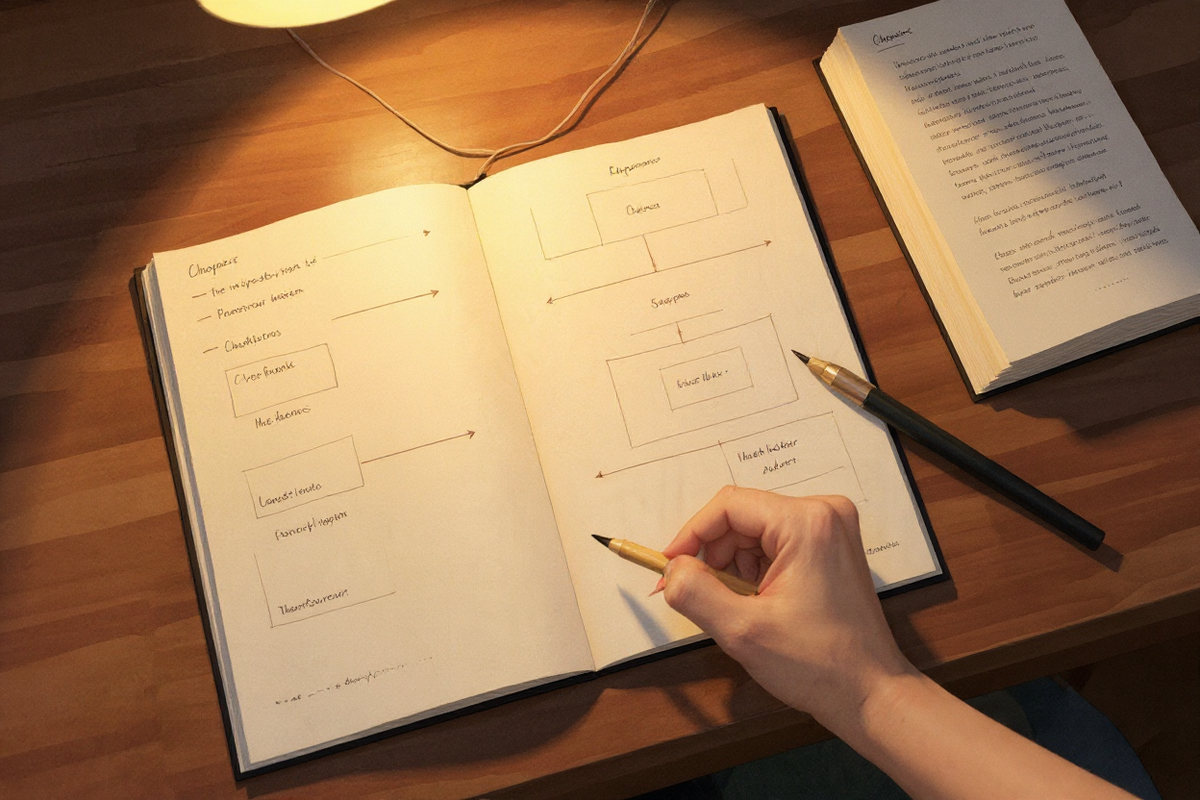
There is a military principle, often paraphrased as "no plan survives contact with the enemy." Helmuth von Moltke the Elder wrote the original in 1871, and the accurate translation is less quotable: no plan of operations extends with any certainty beyond the first encounter with the enemy's main force. Authors discover the same thing around week three. You made an outline — twelve chapters, each with a job. Then you started drafting, and by chapter four the book is pulling somewhere the outline did not predict. So you ask the obvious question: should you stick to your book outline, or throw it out?
The honest answer is no — you should not stick to it. And that is not a license to wing it. The outline survives this process. It survives precisely by changing. The draft is where reality pushes back; the outline is what you update in response. Keep it. Hold it loosely. Revise it on purpose.
That is the post in three sentences. The rest is why, and how to do it without chaos.
Should You Stick to Your Outline? The Steelman First
Before I take the fixed outline apart, let me make its case honestly, because the instinct behind it is correct.
A firm plan feels safe for good reasons. A book is a system — components, dependencies, an order that has to hold across 70,000 words. The outline is the one artifact that lets you see the whole thing at once before you have written most of it. It tells you chapter seven depends on the framework you set up in chapter three, and that the case study you opened with has to still be true when it reappears near the end. Without it you are holding the entire structure in your head, and no one can hold a book in their head.
There is also a real cost to drift. An author who changes direction every session, who abandons the plan the moment a paragraph gets interesting, does not finish. They produce 200,000 words of fragments and no book. The fear of that outcome is rational, and the fixed outline is a defense against it.
So the appeal is not naive. The problem is not that planning is wrong — it is treating the plan as a contract you have signed rather than a model you maintain. Hold that distinction. Everything below turns on it.
Your First Plan Is Provably Wrong — and That's Structural, Not Sloppy
Here is the uncomfortable part. Your first outline is not just probably wrong in places. It is predictably wrong, in a direction you can name in advance.
In 1994, the psychologists Roger Buehler, Dale Griffin, and Michael Ross published "Exploring the 'Planning Fallacy'" in the Journal of Personality and Social Psychology. They asked people to predict how long their own projects would take. The participants predicted, on average, 33.9 days. The projects actually took 55.5 days. That overrun is not the headline, though. The headline is this: the real completion time landed beyond even the participants' worst-case, pessimistic estimate of 48.6 days. People did not just miss. They missed past the margin they had deliberately built in to be safe. (The concept traces back to Kahneman and Tversky in 1979.)
This is what "no plan survives contact" actually measures. Your first plan is structurally optimistic — not because you were careless, but because it was made from inside a task you had not yet done. You cannot see the chapter that will turn out to need three chapters. You cannot see the argument that collapses the moment you try to write it down.
So when your draft drifts from your outline at chapter four, you are not failing. You are receiving information your original plan could not contain. The drift is the plan working. The draft is where the book tells you which assumptions were wrong — the same way the middle of a manuscript is where the real shape of the project surfaces, which is its own kind of signal worth reading correctly. The amateur reads drift as a verdict on the outline. The professional reads it as data for the outline's next revision.
How Writing Actually Works: The Plan Never Stops
If the first plan is predictably wrong, you might expect the answer to be "plan less, write more." It isn't. Planning and drafting are not separate phases at all.
In 1981, Linda Flower and John R. Hayes published "A Cognitive Process Theory of Writing" in College Composition and Communication. It is one of the most cited papers in writing research, and its central finding reshaped how the field understands the act. Writing is not linear — plan, then draft, then review, in order. It is recursive. Competent writers move between planning, drafting, and reviewing continuously. They re-plan in the middle of a sentence. They revise the structure while they are producing the prose. The plan is not a thing you finish before you start. It is a process that runs the entire time you are writing.
That single finding dismantles the fixed-outline model at the root. A contract outline assumes planning happens once, up front, and then you execute. Flower and Hayes showed that is not how the competent mind writing a long work operates. Re-planning during drafting is not a failure of discipline. It is what skilled writers do. A frozen outline does not protect you from your own process. It fights it.
So drift is not the enemy of planning. Drift is planning, continued. The question is never whether the plan changes. The question is whether you change it deliberately, on the page, where you can see it — or whether it changes silently in the draft while the outline sits in a drawer claiming the book still looks like something it no longer is.
The Outline Is a Load-Bearing Instrument — Which Is Exactly Why You Revise It
At this point the case for throwing the outline out entirely starts to look tempting. If the plan is wrong and the process is recursive, why not just write and discover the book as you go?
Because the outline is doing real cognitive work, and you cannot afford to lose it.
In 1988, Ronald Kellogg published "Attentional Overload and Writing Performance" in the Journal of Experimental Psychology: Learning, Memory, and Cognition. He found that outlining before drafting functions as external memory. It offloads structure out of your head and onto the page, which frees up attention for the sentence in front of you — and it measurably improved the quality of the documents people produced. The outline is not ceremony. It is a load-bearing instrument. It carries the part of the book you cannot hold in working memory while you are writing the part you can.
Notice what this does not say. It does not say "make a detailed outline and obey it." It says the outline is valuable as a place to keep the structure outside your head. And an instrument you rely on is exactly the kind you keep sharp — not the kind you freeze. If the outline is your external memory of the book, letting it go stale is the worst of both worlds: you navigate by a map that no longer matches the territory while believing you have a map at all. Kellogg's finding is the strongest argument for revising the outline, not for obeying it — the plan matters too much to leave wrong. This is the discipline the first-week planning sprint is built to establish: the outline as a living instrument from day one, not a document you fill in once and file.
Treat the Outline Like a Spec, Not a Contract
Software ran into this exact problem decades ago and resolved it — and the resolution was not "stop planning."
In 2001, the Manifesto for Agile Software Development stated its fourth value, verbatim: "Responding to change over following a plan." Read the phrasing carefully — it does not say no plan. It values responding to change over following a plan; both sides have worth, and when they conflict, the response to what you have learned is the one that wins. That is the engineering answer to plan-versus-reality. You keep the plan. You let reality override it. You update the plan to match.
The statistician George Box gave us the cleaner version. "All models are wrong" is from his 1976 paper "Science and Statistics." The full line — "all models are wrong, but some are useful" — appears in Box and Draper's 1987 book Empirical Model-Building and Response Surfaces. An outline is a model of a book that does not exist yet. By definition it is wrong; a model that captured every detail would just be the book. It is useful because it is a simplification you can revise cheaply, before the expensive version — the manuscript — is set.
So treat the outline the way an engineer treats a spec. You version it. You refactor it when the structure changes. You keep it in sync with what you are actually building, so that the plan and the manuscript never silently disagree. When a chapter splits in two, the outline learns that. When chapter seven's argument turns out to depend on something you have not set up yet, the outline records the new dependency. This is the same discipline I wrote about in treating your book as a system you can refactor — the outline is the map, and when the territory moves, you refactor the map rather than pretend it still fits.
This is, quietly, most of what our service is for. A human editor decides what the book should become — that judgment is irreducibly the author's and the editor's. The process does the boring, relentless part: keeping the outline and the chapters reconciled as both change, so a revision in chapter three surfaces every place downstream it touches, and the plan you are looking at is always the plan you are actually writing. The decisions stay human. The bookkeeping that makes a living plan possible at 80,000 words is what the system carries.
So, Should You Stick to Your Outline?
Back to the question you came in with. Your outline is drifting at chapter four and you want to know whether you planned wrong.
You didn't. You planned the way every honest first plan is planned — optimistically, from inside a task you had not yet done. The draft is doing its job: pushing back, telling you where the model was wrong. Your job is to listen, and then update the model.
So: keep the outline. Hold it loosely. Revise it on purpose, on the page, every time the draft teaches you something the plan did not know. The first draft is comparatively disposable — you will rewrite most of it anyway. The outline, kept current, is the durable asset, because it is the one thing that holds the whole book in view while the rest of it is still in motion.
The outline survives contact with reality. It just doesn't survive unchanged — and was never supposed to.
If you are mid-draft and want a second set of eyes on whether the drift is the book finding its shape or the structure coming apart, book a free call and we can look at what you are building together.
Andrea Tomasini is founder and system architect of my-book.ai, where he leads the engineering and process design behind the service. He spent two years building the consistency and structural tracking system that sits behind every book project — and two decades before that helping organisations build better systems, a discipline that turns out to apply to manuscripts as much as to software.