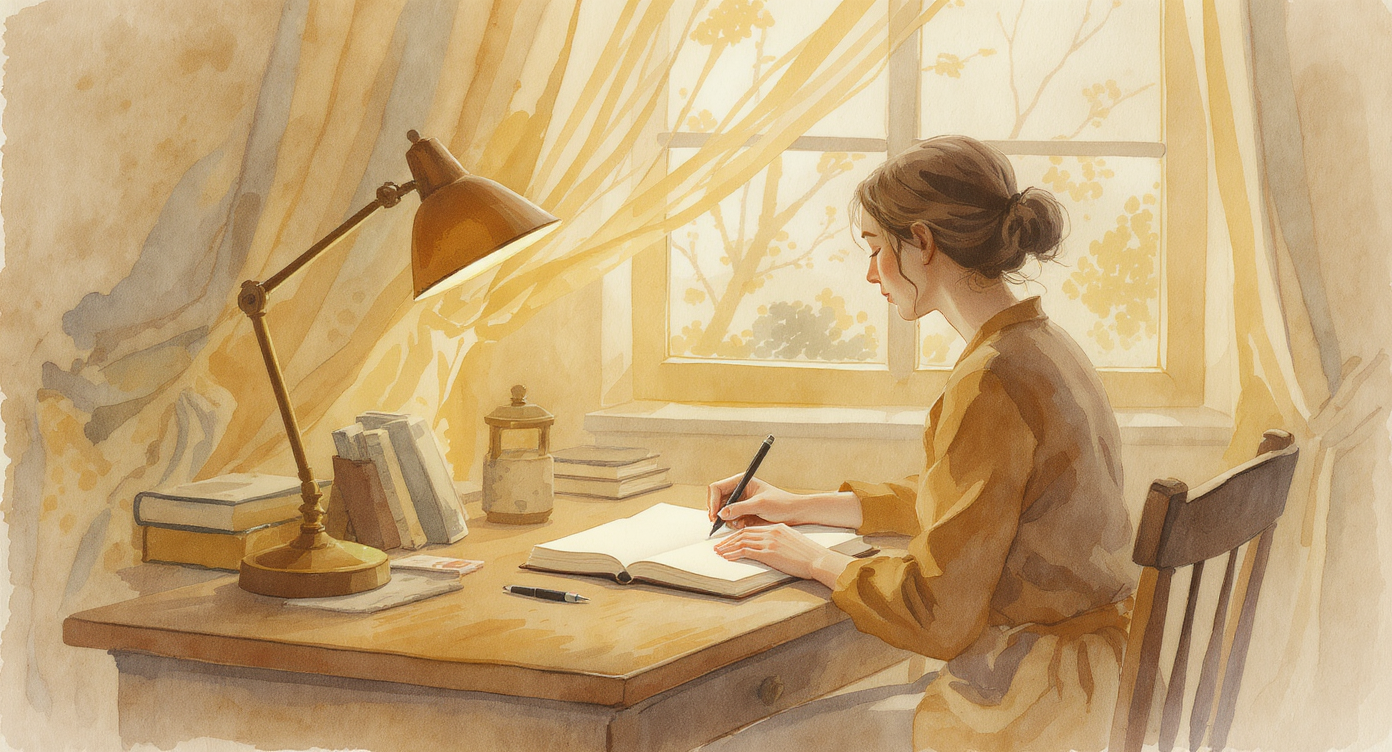
The fear of writing a book doesn't only happen at the desk.
It happens when you try to write a wedding message and suddenly every sentence sounds wrong. When you stare at a blank postcard longer than it would take to write it. When you open an email, type a line, delete it, and start again.
The words are not the problem. You know what you want to say.
And yet, you hesitate.
What we often call overthinking or perfectionism is something more precise. In the moment you begin, writing does not feel like expression. It feels like exposure. The blank page becomes a mirror, and the first sentence is no longer just a sentence — it becomes a signal. Is this good enough? Is this really me?
That quiet shift is what stops people.
And nowhere is it stronger than when starting a book.
The First Chapter Carries Weight That No Other Chapter Does
I once spoke to someone who had been carrying his book for eleven years. He knew the characters, the later chapters, even the tone. But he had never written the first sentence. "I keep sitting down," he said. "And then I don't."
The first chapter carries a weight no other chapter does. Every chapter after the first asks you to continue. The first chapter asks you to cross a threshold. It is the moment where "I have an idea" becomes "I am doing this." That shift is not technical. It is psychological. It is identity-level, and identity is where resistance is strongest.
By chapter twelve, you are already someone who writes. By chapter one, you are still deciding whether you are allowed to be.
I think about this often. In the books we have worked on at my-book.ai, the pattern is always the same. Authors who can describe their entire story in vivid detail over a call — the world, the characters, the scenes they have lived with for years — go quiet the moment they sit down to write the first page. Something changes. The idea, which felt so alive when it was only theirs, suddenly has to survive being put into words. And words can be judged.
The strange thing is that nobody asked them to be judged. The judgment is not in the room. It is in the head of the person writing. It is anticipated, not real. And anticipated judgment is often more paralysing than the real kind, because there is no end to it.
The Cliff Is Not Where You Think It Is
This is not just something I notice in my work. The numbers tell the same story.
A 2021 survey by OnePoll for ThriftBooks asked 2,000 U.S. adults about their writing dreams. More than half believed they had a book in them. But only 15 percent had actually started writing — and just 6 percent had reached the halfway point.
Look at that drop. The steepest cliff is not between the middle and the end. It is between "I want to write" and "I have written." For every ten people who believe they have a book in them, only about three make it to the first page.
The same survey asked what stopped them. The top answer, at 33 percent, was "writer's block" — more than lack of time, more than perfectionism, more than anything else. But that label is misleading. Writer's block suggests a creative failure, something that happens while you are writing. What most of those 33 percent describe is closer to the opposite: the thing that happens before you write, when the sentence is still only a thought and the cost of putting it down feels larger than the cost of leaving it alone.
Most writing advice is designed for people who are already past that point. It teaches you how to outline, how to stay disciplined, how to finish. But the actual block — the one that stops the majority — is not about finishing. It is about beginning. And that block has a shape. It has a mechanism. It even has a name.
What the Fear of Writing a Book Actually Looks Like
Research helps explain why that beginning is so fragile.
A 2024 study by Yosopov and colleagues, published in the Journal of Psychoeducational Assessment, looked at why some perfectionists end up paralysed while others manage to move. They surveyed 327 participants and found something specific: the pathway from perfectionism to procrastination runs through two linked mechanisms — fear of failure and what the researchers call overgeneralization of failure.
That second one is the key.
Overgeneralization of failure is what happens when one weak sentence becomes "I can't write." When one slow session becomes "this isn't going anywhere." When one imperfect page becomes "maybe this book was a mistake."
The problem is not the bad sentence. The problem is what your mind does with the bad sentence. It takes one small stumble and turns it into a verdict on who you are. And once a single attempt feels like a verdict, the safest move becomes obvious: don't try again.
This is why "just start" rarely works. The resistance is not practical. It is protective. Your mind is not failing you. It is shielding you from what it reads as danger — the danger of finding out that you might not be the writer you hoped you were.
I read that study and thought about my author with the eleven-year book. He was not afraid of writing. He was afraid of what writing a bad first page might mean about him. The blank page was not blank. It was a mirror.
And once you see that mirror for what it is, something changes. The fear does not disappear. But it stops being a verdict on your ability and starts being what it actually is: a very ordinary response to a very high perceived stake. That reframing is not a trick. It is simply the truth that the research makes visible.
The Way Through Isn't Around It. It's Smaller Than It.
What does work is smaller. When the stakes disappear, the mechanism weakens. A paragraph that does not matter cannot define you.
This is why it is often easier to write something trivial than something important — a fragment, a side scene, a sentence that is not meant to carry weight. And once you have written something, however small, something shifts. You are no longer someone who might write. You are someone who has written.
I have seen this again and again. People who were stuck for years at the first chapter begin to move once they stop treating it as a test and start treating it as a sketch. The cathedral comes later. It is built from the sketchbook. And the sketchbook does not need to be good. It just needs to exist.
What does that look like in practice? A paragraph about a room that may never appear in the book. A scene from the middle, where two people disagree about something small. A description of a smell, a weather, a walk. Not chapter one. Not even a chapter. Something that is allowed to be imperfect because nothing was ever going to depend on it.
Then another small thing. Then another.
The first chapter does not come first. It emerges later, from momentum.
The Question Underneath
The author with the eleven-year book did not begin with his opening. He started small, almost accidentally — a paragraph about his grandfather's hands, which had nothing to do with the book he thought he was writing. Then a scene from a winter morning. Then a conversation that surprised him. Weeks later, a first chapter appeared — not planned, but real.
Nothing about his ability had changed. Only the meaning he gave to each sentence.
So the question underneath all of this is simple: if a bad sentence didn't mean anything about you, what would you write?
Most people, when they answer that honestly, realise they already know. The book has been there for a while. What has been missing is not the ability. It is the permission.
Because whether it is a book, a postcard, or an email, the difficulty is rarely the writing itself. It is the moment where writing starts to feel like a judgment.
And the way forward is smaller than we think.
Once a few of those small things exist, the next question is structural — what they are quietly building. Andrea has written about the architecture underneath a manuscript and the five commitments of a first-week sprint, which are where the small fragments start to find their shape.
Marion Eickmann-Tomasini is co-founder of my-book.ai, where she reads every chapter of every book project personally. She is the author of The Splinter of Memory, the first volume of the Velirion Chronicles. Before books, she spent more than fifteen years helping leaders see their own thinking clearly — a habit she now applies, chapter by chapter, to first-time authors.
Ready to take the first small step? Book a free discovery call →