I found the contradiction on a Tuesday evening, around page 280.
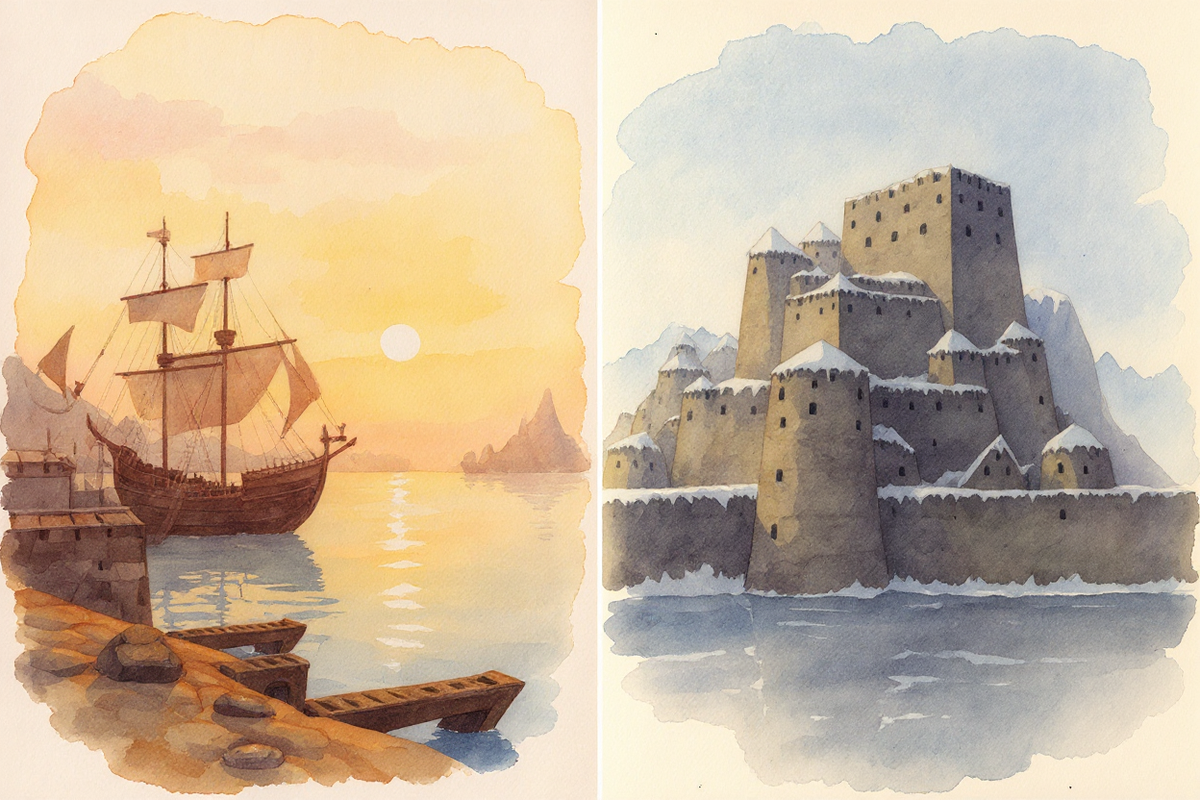
Chapter 4 had established Velarys as a coastal trading port — salt air, merchant ships, the smell of low tide. I'd written that scene myself, with the AI as my creative partner, and I knew it the way you know a room in your childhood home.
Chapter 14 called it a mountain fortress — the exact kind of mistake every AI book writing tool eventually makes.
Not a small inconsistency. A complete transformation of geography, strategic logic, and the entire political identity of the place — and the AI had no memory of ever writing anything different. When I pointed it out, it apologized cheerfully and suggested a revision. That revision introduced three new contradictions.
That's the moment I understood what was actually wrong: these tools don't remember your book. They remember the last few pages.
The Book That Started Everything
The first book produced through what would become my-book.ai wasn't fiction at all. It was The Intentional Workplace: Walk the HYBRID Way — a nonfiction guide to hybrid work practices, co-authored with Andrea Tomasini, my partner and the founder of my-book.ai.
That book taught us something important: even professional nonfiction creates real consistency challenges when you're working with AI. Getting footnotes right. Keeping citations accurate. Making sure chapter 12 doesn't quietly contradict chapter 3. The small details that readers trust you to get right — those are exactly the details that AI tools lose track of first.
The book proved that human creativity and AI collaboration could produce something genuinely good. But it also showed us the cracks. The AI would drift. References would shift. The further we got from the beginning, the less reliable everything became.
We didn't realize how much worse it could get.
When Fiction Raised the Stakes
Then I started building the Velirion Chronicles — a planned fantasy trilogy — and every limitation that nonfiction had politely hinted at came crashing through the door.
Here's what people don't realize about writing fantasy: it's not just writing a story. It's building an entire world, then writing a story inside it. Races, alliances, magic systems, geography, political structures, character arcs that must hold. In nonfiction, a character doesn't evolve. In fantasy, they must — and the world has to evolve with them, consistently, across hundreds of pages.
I co-created the Velirion world with AI as my creative sparring partner. We built it together. But as the world grew more complex, every general-purpose AI tool I tried failed in the same way: brilliantly at first, then badly. The first few chapters would be sharp and consistent. Then, somewhere around chapter ten, things would start to slip — consistently, across every tool I tried.
Which brings me back to Velarys. The coastal port that forgot it was coastal.
Why AI Book Writing Tools Suffer From Digital Amnesia
The failure has a name. And it's not user error.
Researchers call this the "lost in the middle" phenomenon (Liu et al., Lost in the Middle: How Language Models Use Long Contexts, arXiv:2307.03172, 2023): AI attention degrades sharply for information sitting in the middle of a long context window. It reliably processes what's at the very beginning, and what's at the very end. Everything in between? That's where your world goes to die.
What does that mean for a book? The middle is where most of your story lives.
Character backstories established in act one. Alliances formed in the first third. World rules that your climax depends on — all sitting in the middle of a growing manuscript, growing less visible to the AI with every chapter you add.
Is it any wonder the magic system changed its own rules?
And this isn't a quirk of one model or one product. The same study found identical U-shaped degradation across GPT-3.5 Turbo, Claude 2.0, and Llama 2 — a structural property shared across the entire generation of large language models, not a flaw of any single tool (Liu et al., arXiv:2307.03172).
How many authors have blamed themselves for these failures, assuming they asked the wrong question or used the wrong prompt — when the tool was simply forgetting?
What I Needed — and What Didn't Exist
I didn't need a better chatbot. I didn't need a fancier prompt template. I needed a process that could hold an entire world in memory — every character, every relationship, every rule — and enforce consistency across hundreds of pages while still leaving room for creative surprise.
Nothing like that existed. So Andrea built it.
Not a plugin. Not a prompt technique. A purpose-built writing system. Two years of engineering from someone who has spent a lifetime building systems that have to hold together under pressure — the kind of work you do when you finally have a problem that deserves that level of effort.
When Andrea applied this system to the Velirion Chronicles — the same project that had broken every other tool — something unexpected happened. The consistency problems that had plagued both the nonfiction and the fiction simply stopped. The dramaturgy held. Characters stayed true. World rules remained intact across hundreds of pages.
The coastal trading port stayed coastal.
Why This Matters Far Beyond Fantasy
Here's what we didn't expect: the improvements Andrea made to handle fantasy's extreme complexity made the system capable of supporting any kind of book.
Think about what a consultant needs when writing an authority book: a consistent methodology across 200 pages, case studies that don't contradict each other, a framework that holds from chapter one through the conclusion. The consistency challenge is different in flavor, identical in structure.
An entrepreneur documenting a business model needs every principle to connect logically — across chapters written months apart. A retiree writing a memoir needs events, people, and timelines to stay accurate across decades of life story. Each brings their own version of the same challenge: hold this together for me, all the way through.
The system that grew from solving the hardest possible case — a full fantasy world with its own rules, history, and politics — turned out to solve all of them. That's not something we planned. It's something we discovered.
That discovery — tested and refined across nine published books — has become the collaborative writing service at my-book.ai. Not a tool you use alone. A process with a dedicated editorial partner who holds your entire book in memory so you can focus on what only you can provide: the ideas, the voice, the vision.
The Question That Started It All
When I read a chapter of the Velirion Chronicles today, I can feel the difference. The world holds. The characters are themselves. Nothing has quietly changed between page 80 and page 280.
That feeling is what every author deserves.
If you've ever tried to write something longer than a few thousand words with AI assistance, you've probably felt the moment it frays. The carefully constructed argument that starts contradicting itself. The world that slowly, quietly stops being the world you built.
That's not a failure of imagination. It's a fundamental limitation of how these tools work — one that no prompt trick or context window expansion has fully solved.
And if you've felt that frustration, you already understand why we built something different. Not a tool that writes for you — but a collaborative process that keeps your ideas, your voice, and your world consistent from the first page to the last.
Your story deserves that. Whether it's set in a fantasy world, a boardroom, or a life fully lived.
Marion Eickmann-Tomasini is co-founder of my-book.ai, where she leads editorial for every book project. She is the author of The Splinter of Memory, the first volume of the Velirion Chronicles. When she's not building fantasy worlds, she's reading your first chapter and figuring out how to make it better.
Ready to see if your book idea is ready? Book a free discovery call →